Biographical Essays
Below are a series of short biographical essays, focusing on notable students who attended the College between 1862 and 1918.
These are designed to serve as case studies to represent the research potential and fascinating life stories that are waiting to be discovered amongst surviving archival resources.
Our hope is that it will inspire further work and research into the College students and their lives.
Case studies
A
B
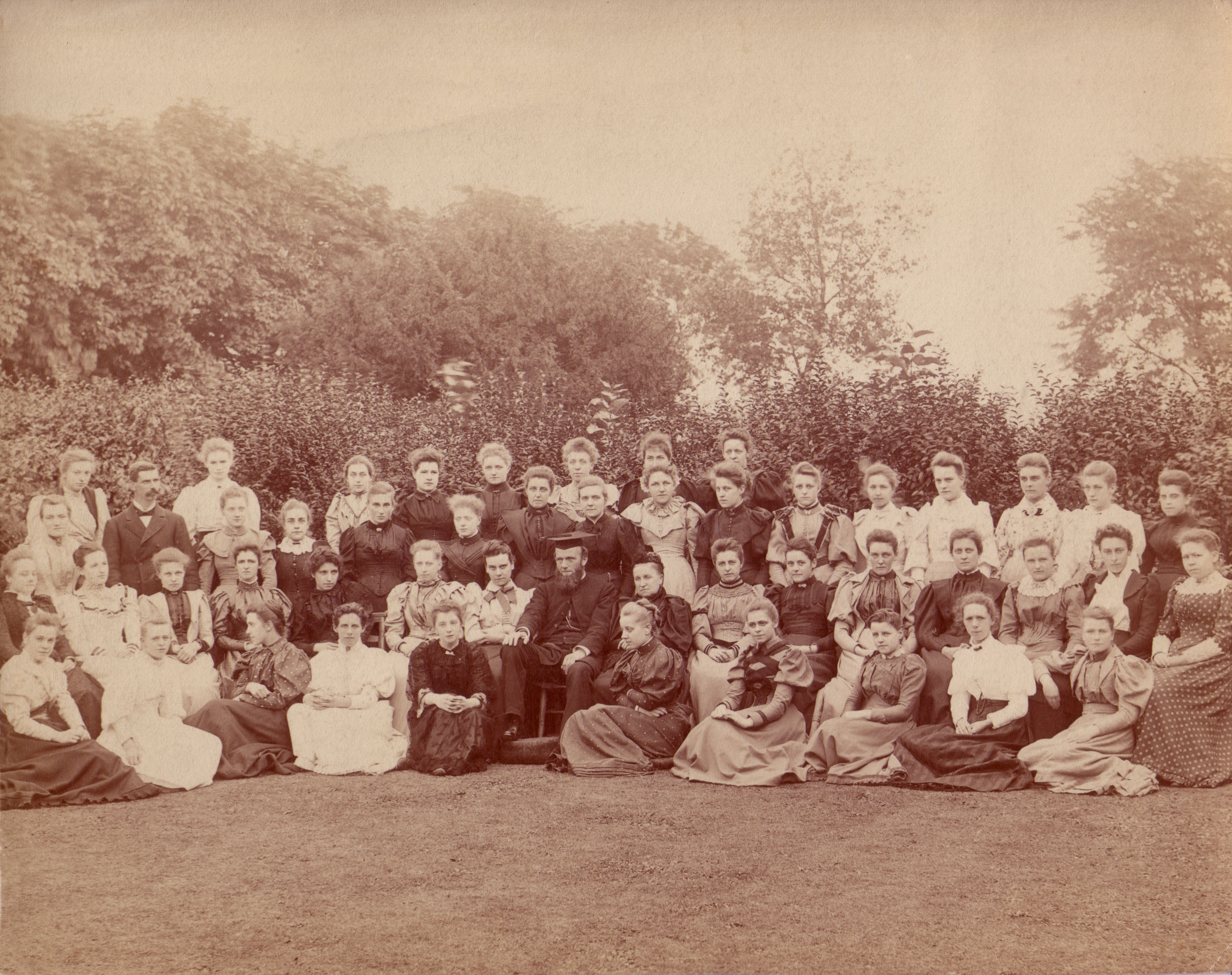
Matilda Bourne (1858-1954)
Matilda (o/w Maud) (o/w Madeleine) Elizabeth Bourne
Matilda Bourne was a student at Lincoln Diocesan Training College (LDTC) January 1878 - December 1879 after being a pupil-teacher in Birmingham. Her first post was at Wyberton Mixed School, near Boston, Lincs, and she was awarded her full ‘parchment’ (certificate) in 1881. In 1899 she is recorded as being at St. Luke’s Girls School, Kingston-on-Thames.[1]
In 1908 she sailed for Australia to join the staff of the Parkerville Children’s Home, Perth, as their school teacher. Parkerville had been opened in 1903 by two nuns from the Community of the Sisters of the Church (CSC), an Anglican order established in London in 1870. Initially the children went to the local school but as their numbers increased a schoolroom was added to the building. According to Kevin Casey, Matilda was a friend of Sister Kate, the founder of the home.[2]
A letter from Matilda was published in the Lincoln Diocesan Training College magazine (April, 1908) in which she described part of her journey to Perth. She had chosen not to go ashore at Cape Town when she found that she had to
… go down a very steep ladder with only a rope hand rail, then get from that into a little motor boat, I was too much of a coward to venture.
She had sailed aboard the SS Suevic on 18 January 1908 and anticipated arriving in Albany, Western Australia, several weeks later, from where it would be a thirteen-hours railway journey to Perth.[3] It is of note that Matilda appears to have preferred the name Maud as she becomes named as such in several issues of the college magazine.
She wrote again in 1912 but an extract from the letter was not published in the magazine until April, 1913. In this she describes much of the home in detail, both its buildings and the daily routine. There were two bedrooms attached to the schoolroom, one of which is hers, the other the schoolmistress’s. She says that she is now the housekeeper and dislikes her storeroom because she finds it ‘most dreadfully difficult to calculate exactly what to order for such a family.’ By this time there were 123 children plus the sisters and other staff (Casey, p.55). At the end of January, 1912, Matilda had been professed as a sister of the order, along with two others, after being received as a novice in November, 1908. She was now called Sister Madeleine.[4]
Kevin Casey confirms that Sister Madeleine remained in an administrative role at Parkerville and this is supported by many letters from her in local newspapers either appealing for goods or financial support or thanking supporters for these.[5]
The West Australian reports her retirement from Parkerville back to the UK and the presentation of a framed testimonial from the board of control to ‘the great work [she] has carried on at the Children’s Home for the past 25 years.’ The board expressed their,
admiration for her and wished her many years of happiness and strength to continue in the great Christian cause to which [she] had devoted her life.
Her devotion and unselfishness had been boundless.[6] According to Casey, the philosophy of the home was way ahead of its time. Sister Kate espoused a ‘cottage’ system of care where children lived in small family groups and siblings were kept together. There was little punishment, rather an emphasis on correct behaviour and a reward system to reinforce it. Picnics took place in the bush and there were regular trips to the beach.[7]
Records from the archive of the CSC indicate that Sister Madeleine lived at the main convent in Kilburn on her return to England where she helped in the Embroidery Room, Office and eventually with the oldest girls. During WW2 she was evacuated and went to stay with her sister in Edgbaston. After the war she went to St. Mary’s, Broadstairs, a convalescent home and orphanage run by the CSC. By now, although ‘quite frail’, she knitted strips which were made into blankets, and ‘Her Parkerville “Children” kept in touch with her to the end … her passing left a gap in their lives.’ (Archivist, CSC, personal communication, 21 July, 2020).
Sister Madeleine died in 1954 a few days short of her 96th birthday. Her death was reported in the Australian press where it was noted that she was the last of the original sisters to work with Sister Kate, the founder of the Parkerville Children’s Home.[8] They were ‘women who had a vision for a better world for discarded and unwanted children’ and who ‘altered dramatically for the better the care and support of vulnerable children … for over a century.’[9]
Endnotes
[1] LDTC, 1879. Record card, Matilda Bourne
[2]Casey, K. 2010. Parkerville. Caring for Children. Caring for their future. Perth, Parkerville Children and Youth Care.
[3] Bourne, Maude (1908). Old Students Pages. LDTC magazine, April, pp.6-7.
[4] Bourne, Maude (1913). Old Students Pages. LDTC magazine, April, pp.10-12.
[5] Madeleine, Sister, (1915, April 13). The Waifs Home. The West Australian (Perth), p.8. Madeleine, Sister, (1921, November 2). Children’s Home, Parkerville. The West Australian (Perth), p.10. Madeleine, Sister, (1921, April 23). Children’s Home, Parkerville. Kalgoorlie Miner (WA), p.1. And many more.
[6] The West Australian (1933). Sister Madeleine Honoured. The West Australian, January 21, p.16
[7] Casey, pp.49-51.
[8] The West Australian (1954). Noted Worker for Children Dies in London. The West Australian, 18 August, p.16.
[9] Casey, p.8.
Mildred Vaughan (1878-1937)
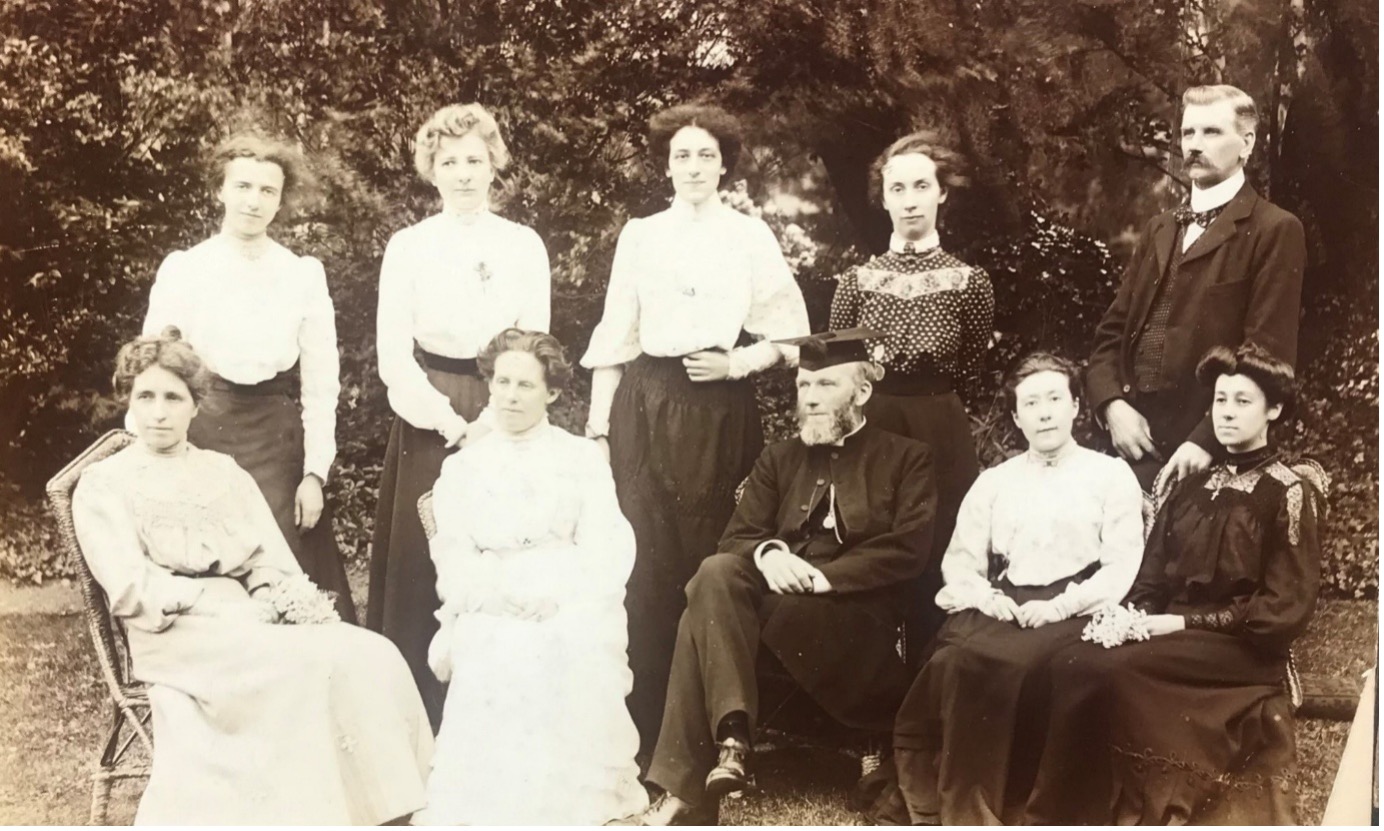 Photograph, ca. 1901-1908: Mildred is sitting 2nd from right looking direct at camera. (Lincoln Bishop University Archive)
Mildred Agnes Vaughan
Mildred Agnes Vaughan was born on 30th September 1878 in Heapham, Gainsborough, the fourth of six children born to Thomas Browne Vaughan, the Rector of Heapham, and Agnes Coleman Hallowes.[1] After her father’s death in 1889, the family moved to 19 Newport, Lincoln, to live with her maternal uncle, Richard Hallowes, a Civil Service Committee Clerk.[2]
In the years preceding her college entrance, Mildred worked as a Pupil Teacher at the Practising Girls’ School in Lincoln.[3] She entered Lincoln Diocesan Training College [LDTC] in September 1897, having successfully attained her Queen’s Scholarship at Christmas 1896.[4] Mildred spent two years as a boarder at LDTC and was, by all accounts, a superior student. Her student record card describes her character as ‘excellent all round both in work and conduct. Has experienced very great and very marked influence in college. A refined woman of high tone’.[5]
As a teacher, Mildred is described as ‘Excellent. Bright. Vigorous. Complete command, quiet and dignified. Lessons well selected, very carefully prepared. Accurate – industrious - full of sympathy. Keeps her class well at work and takes care that they are really understanding’.[6]
Mildred certainly made her presence known in college, as the College Magazine regularly records her participation in events. She joined the Girls’ Friendly Society on 12 November 1897; remained in college during the Christmas holidays of 1897 to assist with examinations; won first place in rope climbing at the summer 1898 sports day; and, in September 1898, was appointed Hockey Captain and President of the Debating Society.[7] She was also heavily involved in recitals and dramatic performances.
Mildred left college with a First Class in Religious Knowledge and a First Division in Parts I and II of the Certificate Examination.[8] Her first appointment was at Norwich Training College as a governess, where she received a salary of £60 per year with board and lodgings.[9]
However, it was not long before Mildred was invited back to LDTC as a governess, later becoming the prestigious ‘Mistress of Method’.[10] As in her student years, she is frequently mentioned in the College Magazines from 1901 onwards: she appears as President of the Games Club in October 1901; led a party of Second Years to Nottingham schools in April 1902; passed the First Aid Examination in April 1903; served as Fiction Librarian in October 1903; and organised a student Shakespeare recitation in April 1904.[11]
In the April 1908 Magazine it is noted that ‘Miss Vaughan sailed in January to Mexico, where she is to spend a long and much-needed holiday with her brother and his wife’.[12] Her brother, Thomas Hallowes Vaughan, was working between Mexico and San Francisco as a chemical manufacturer. Interestingly, Thomas’s wife, Elsie Piper, was both Principal Canon Rowe’s niece by marriage and a former LDTC student (1898–1900).[13] As the Magazine continues: ‘We hope to have a letter from Miss Vaughan for the October number. She has had a good journey, but with some delays and adventures, and is possibly at the same time indulging in a good “College talk” with her sister-in-law, who is known to so many of us as Miss Elsie Piper’.[14]
As promised, the October 1908 Magazine includes a letter from Mildred describing her travels to Mexico, titled ‘A Second Journey to Mazatlán’.[15] However, by April 1909 it appears she had decided not to return to LDTC: ‘We have to record with great regret the resignation of Miss Vaughan, who left in January 1908 for a year’s holiday in Mexico. Later, however, Miss Vaughan decided to join her sister, who is working in the Diocesan High School at Auckland’.[16]
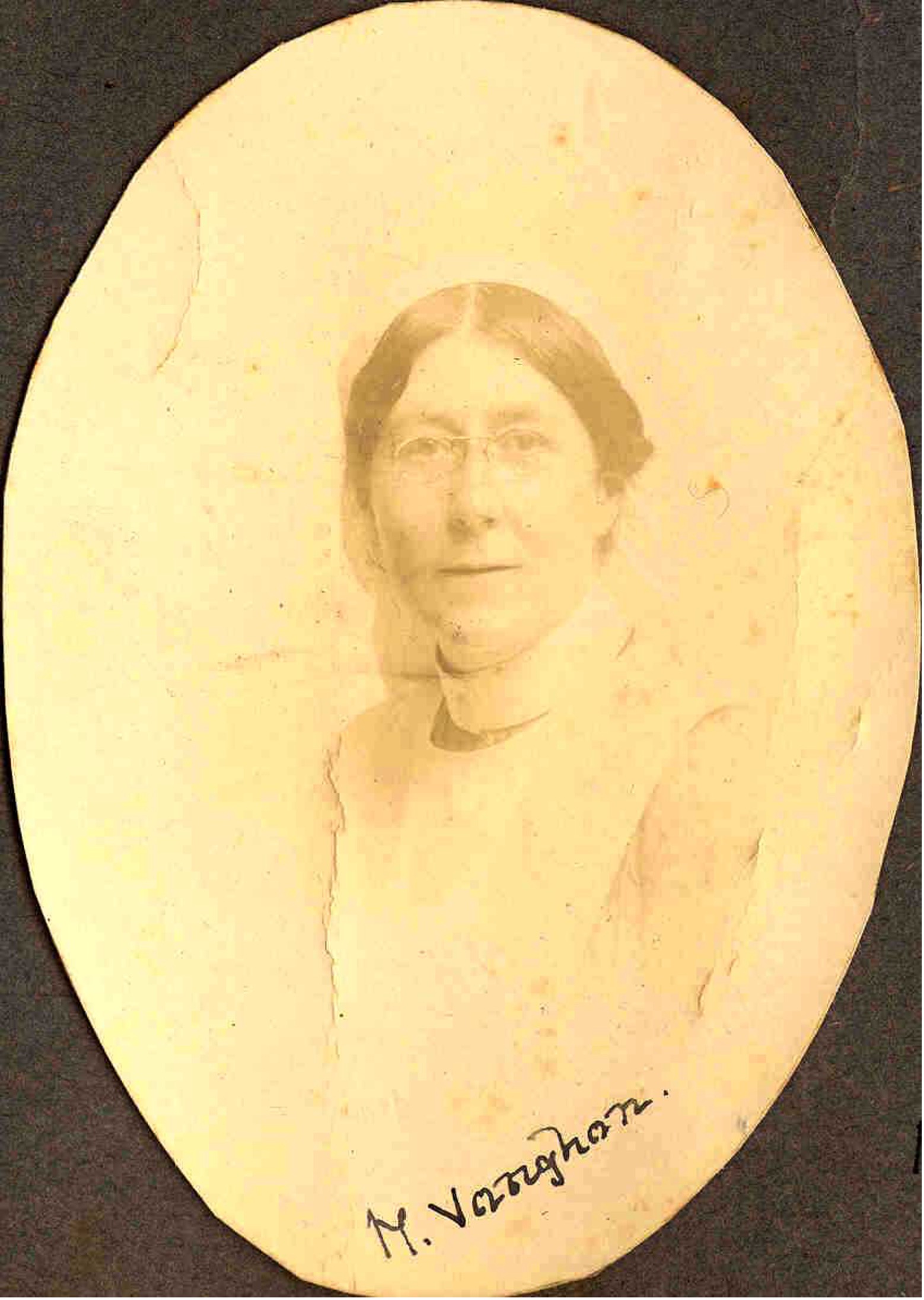
Auckland, Diocesan School for Girls Archive, Series 200 Photo Albums, Selwyn House Album
As promised, the October 1908 Magazine includes a letter from Mildred describing her travels to Mexico, titled ‘A Second Journey to Mazatlán’.[15]
However, by April 1909 it appears she had decided not to return to LDTC: ‘We have to record with great regret the resignation of Miss Vaughan, who left in January 1908 for a year’s holiday in Mexico. Later, however, Miss Vaughan decided to join her sister, who is working in the Diocesan High School at Auckland’.[16]
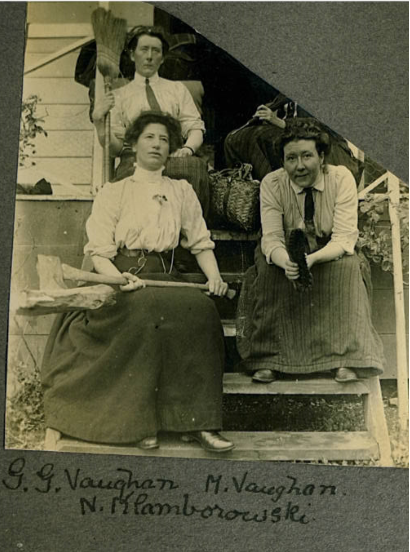
Auckland, Diocesan School for Girls Archive, Series 200 Photo Albums, Selwyn House Album
A letter entitled ‘Four Years in Auckland, N.Z.’ was published in April 1914.[17] It largely describes the landscape, climate, and local people; however, Mildred also comments on New Zealand’s 1914 franchise amendment:
‘The women whom I knew all exercised their vote as a matter of course and did not appear to be unsexed by doing so’.[18] She concludes: ‘New Zealand needs keen Churchmen and women to give her children the priceless blessing of a religious education… She has done marvellous things in the last fifty years and great opportunities lie before her. She talks of England as “Home” and I defy anyone to live with her and not love her’.[19]
Mildred left New Zealand for a holiday in England in 1913 but was unable to return to Auckland due to the outbreak of war.
During the First World War, Mildred and her sister Gertrude became nurses with the Voluntary Aid Detachment (VAD).[20] The October 1915 Magazine records: ‘Mildred Vaughan is another VAD who gave valuable help last winter to the Lincoln Boultham Hospital, and is now attached to the Woolwich Hospital’.[21] One of her colleagues from Auckland later wrote: ‘Miss Mildred Vaughan has been twice to see me, so well and happy in her work, and so pleased at having had the experience of a trip to Mudros, when they brought back 3,662 wounded soldiers!’[22]
Her war work is further noted in the April 1917 Magazine: ‘One of these full-time workers, Miss Vaughan, seems absolutely ubiquitous… She was in the Royal Herbert Hospital, Woolwich; she has been out to Lesbos on a hospital ship; has served in King George’s Hospital, London; [has been at] the 3rd Southern Military Hospital at Oxford; and is now off to the front in France’ (p. 17).[23]
After her service during the war, she worked as an education administrator and retired to a quiet life at 4 St Giles Avenue, Lincoln, living with her sisters.[24] She passed away suddenly at home at the age of 58. The 1937 Magazine includes the following tribute written by Principal Constance Stewart:
Miss Mildred Vaughan, whose death took place in Lincoln on June 25th, had been closely connected with the College for many years, first as a student, then for several years as a member of staff… During recent years her health had failed a good deal, but she always remained cheerful and alert; she was keenly interested in all that concerned the College, and only a few weeks ago she promised to serve on the committee appointed to deal with the memorial to Miss Elwell. The students who were taught by her will remember her whole-hearted devotion to her work, and the personal interest she took in each of them. She earned and kept their affection, and she leaves behind her a large circle of friends both in Lincoln and amongst old students all over the country.[25]
Endnotes
[1] ‘Mildred A Vaughan’, Census Return for Heapham, Gainsborough, Lincolnshire (Public Record Office: RG11/3297, folio 65, 1881) p. 6. Available from: https://search.findmypast.co.uk/record?id=GBC%2F1881%2F4316078%2F00440&parentid=GBC%2F1881%2F0014931751
[2] ‘Mildred Vaughan’, Census Return for Newport, Lincoln, Lincolnshire (Public Record Office: RG12/2592, folio 76, 1901) p. 2. Available from: https://search.findmypast.co.uk/record?id=GBC%2F1891%2F2592%2F0155&parentid=GBC%2F1891%2F0017745461
[3] Lincoln, Lincoln Bishop University Archive (LBUA), Lincoln Diocesan Training College Magazine Issue 6, p. 26.
[4] Ibid. p.26.
[5] Lincoln, LBUA, Student Record Cards 1897-1899, Mildred Agnes Vaughan
[6] Ibid.
[7] Lincoln, LBUA, Lincoln Diocesan Training College Magazine Issue 7, p. 18; Lincoln Diocesan Training College Magazine Issue 8, pp. 18-22.
[8] Lincoln, LBUA, Student Record Cards 1897-1899, Mildred Agnes Vaughan
[9] Lincoln, LBUA, Lincoln Diocesan Training College Magazine Issue 10, p. 31
[10] Lincoln, LBUA, Student Record Cards 1897-1899, Mildred Agnes Vaughan
[11] Lincoln, LBUA, Lincoln Diocesan Training College Magazine Issue 14, p. 37; Lincoln Diocesan Training College Magazine Issue 15, p. 20; Lincoln Diocesan Training College Magazine Issue 17, p. 29; Lincoln Diocesan Training College Magazine Issue 18, p. 38; Lincoln Diocesan Training College Magazine Issue 19, p. 36.
[12] Lincoln, LBUA, Lincoln Diocesan Training College Magazine Issue 27, p. 42.
[13] Lincoln, LBUA, Student Record Cards 1898-1900, Elsie Piper
[14] Lincoln, LBUA, Lincoln Diocesan Training College Magazine Issue 27, p. 42.
[15] Lincoln, LBUA, Lincoln Diocesan Training College Magazine Issue 28, pp. 13-15.
[16] Lincoln, LBUA, Lincoln Diocesan Training College Magazine Issue 29, p. 28.
[17] Lincoln, LBUA, Lincoln Diocesan Training College Magazine Issue 39, pp. 8-11.
[18] Ibid. p. 11.
[19] Ibid. p. 11.
[20] Lincoln, LBUA, Student Record Cards 1897-1899, Mildred Agnes Vaughan
[21] Lincoln, LBUA, Lincoln Diocesan Training College Magazine Issue 42, p. 6
[22] Auckland, Diocesan School for Girls Archive, Chronicle No. 19, June 1916, p. 21.
[23] Lincoln, LBUA, Lincoln Diocesan Training College Magazine Issue 45, pp. 17-18.
[24] ‘Mildred Agnes Vaughan’, Census Return for 4 St Giles Avenuet, Lincoln, Lincolnshire (Public Record Office: RG15/15371, schedule 226, 1921). Available from https://search.findmypast.co.uk/record?id=GBC%2F1921%2FRG15%2F15371%2F0459&parentid=GBC%2F1921%2FRG15%2F15371%2F0459%2F01
[25] Lincoln, LBUA, Lincoln Diocesan Training College Magazine Issue 67, p. 10.